
Practical guides · local
Preparing Moore County Plumbing for a Freeze
A practical freeze-preparation guide for Moore County homes: disconnect hoses, protect exposed supply lines, locate the water shutoff and recognize when suspected frozen pipes need professional help.
What you’ll learn
- Disconnect outdoor hoses and confirm the draining requirements for each faucet design.
- Prioritize exposed supply lines and plumbing in unheated spaces or exterior-wall cabinets.
- Locate the main shutoff before cold weather and plan for possible loss of heat.
- Never thaw pipes with an open flame; seek help for hidden, damaged or unsafe-to-reach piping.
- Check for leakage after thawing, including when outdoor faucets return to use.
Before freezing weather reaches Moore County, focus on the plumbing most exposed to cold: outdoor hose connections, supply lines in unheated spaces and pipes near exterior walls. Then make sure you know how to stop the water if a line leaks. These priorities follow American Red Cross and North Carolina emergency-preparedness guidance, but the right steps depend on your home's layout and equipment—not a single checklist applied blindly to every property. (redcross.org)
Start with exposure, not a warning headline
For a home in West End, Pinehurst or elsewhere in Moore County, preparation should follow the actual pipe route—not assumptions about the neighborhood. Start with outdoor faucets, then look for water lines in garages, crawl spaces, attics and cabinets against exterior walls. These are common freeze-prone locations identified by the American Red Cross. Include both hot- and cold-water supply lines. (redcross.org)
Check the forecast before cold weather arrives. National Weather Service Raleigh issues Freeze Warnings during the locally defined growing season, so that headline is not a year-round signal for protecting plumbing. Use forecast temperatures and the exposure of your own pipes to guide preparation, even when no Freeze Warning appears. (weather.gov)
Disconnect hoses and understand how each faucet drains
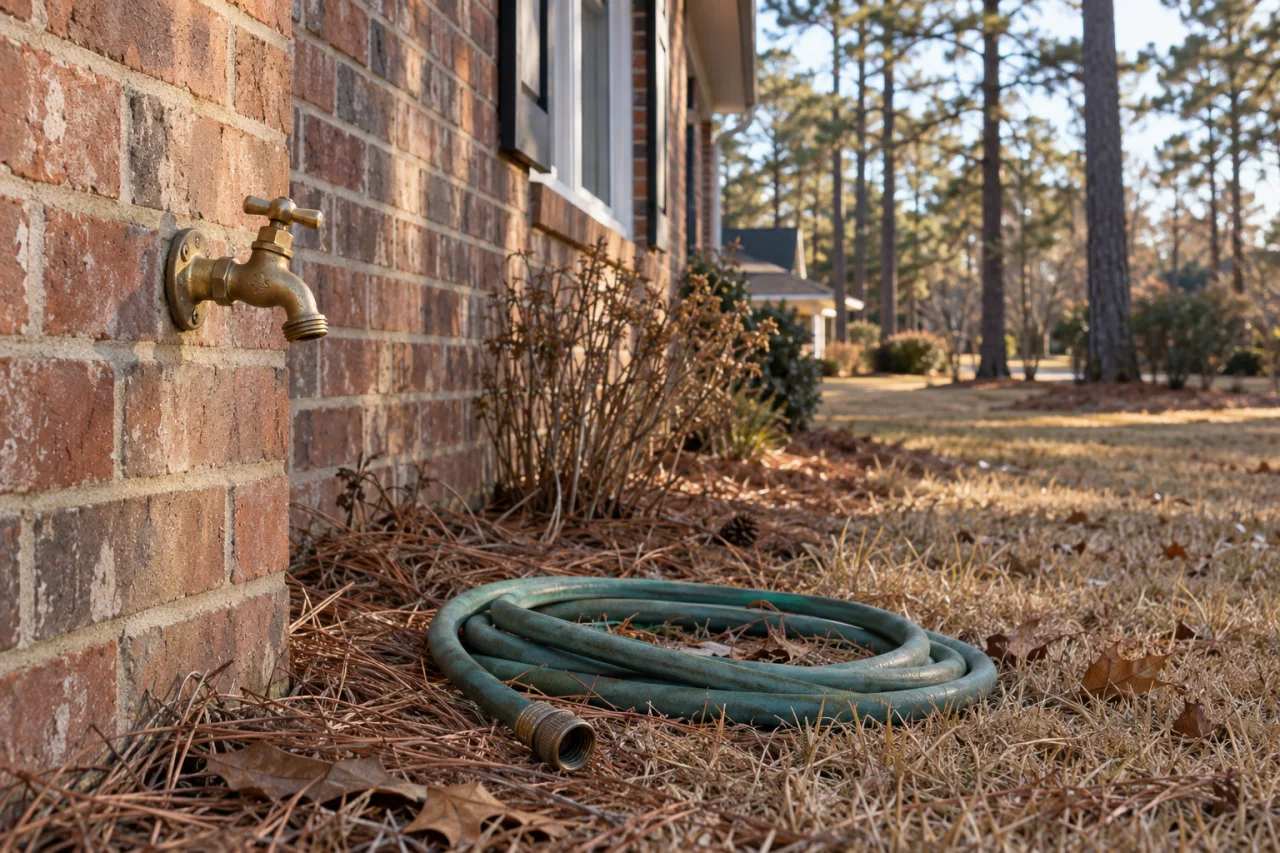
Remove, drain and store garden hoses before freezing weather. Where an outdoor faucet has a dedicated indoor supply valve, the Red Cross recommends closing that valve and opening the outdoor faucet to drain, leaving the outdoor valve open. First confirm that this is the appropriate arrangement for your installation. Irrigation lines require their manufacturer's or installer's winterizing directions rather than an improvised draining method. (redcross.org)
Do not assume that “frost-free” means maintenance-free. Woodford's explanation of its standard frost-proof faucet shows why hose removal matters: trapped water can freeze inside the tube. Correct downward pitch also allows drainage. Those details apply to that design, not automatically to every outdoor tap. If you cannot identify the faucet or its isolation valve, ask for model-specific guidance before operating unfamiliar valves. (woodfordmfg.com)
Match pipe protection to the space
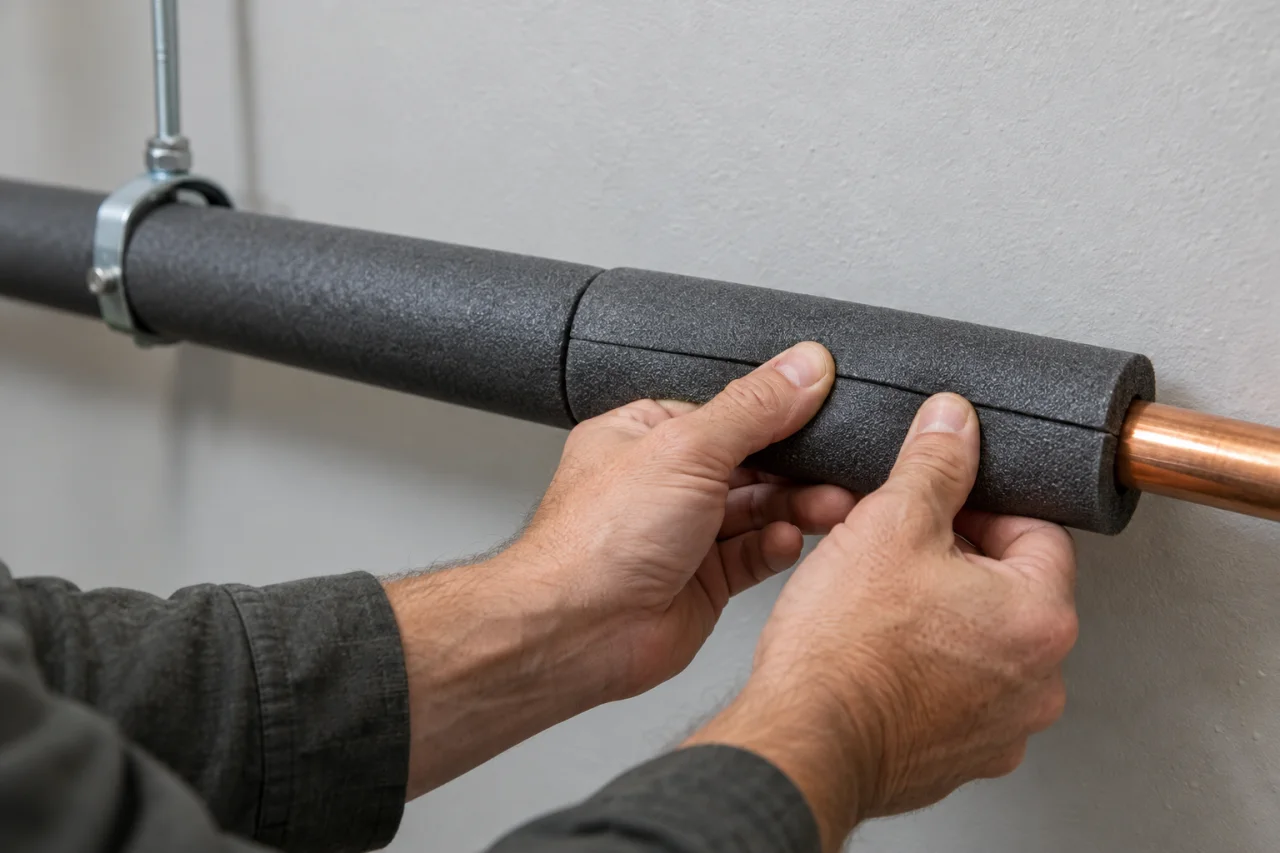
Accessible water lines in unheated spaces deserve a closer look before the forecast turns cold. Pipe sleeves should match the pipe diameter and fit without gaps between sections. The Department of Energy's Building America guidance also identifies air sealing around pipe penetrations and insulation between piping and the exterior as important protective measures. Simply covering one visible straight section may leave the surrounding exposure unresolved. (basc.pnnl.gov)
Choose the measure that fits the problem. Insulating a pipe, draining an unused outdoor branch and adding electric heat are different approaches—not interchangeable products. For recurring freezing, ask whether improving the surrounding enclosure or relocating the line would address the cause more effectively than repeatedly adding temporary protection. (basc.pnnl.gov)
Freeze-preparation options: where they help and what they do not replace
| Measure | Useful application | Important limitation |
|---|---|---|
| Pipe insulation | Accessible supply lines exposed to cold | Needs snug, continuous coverage; surrounding air leaks also need attention. |
| Outdoor branch shutoff and draining | Seasonal faucets with an appropriate isolation arrangement | Depends on the installation; not every faucet has a separate indoor valve. |
| Electric heat cable | Vulnerable piping where a suitable listed product is appropriate | Requires correct installation, electrical protection and ongoing inspection. |
Help indoor warmth reach vulnerable plumbing
During very cold weather, keep garage doors closed where water lines run through the garage. Open kitchen and bathroom sink cabinets so room heat can reach the plumbing, moving cleaners out of children's reach first. Keep the thermostat steady rather than using a lower overnight setting. These measures are especially relevant where supply lines sit near exterior walls. (redcross.org)
If a sink area repeatedly loses flow during freezes, make that history part of a Bathroom Plumbing discussion before the next cold spell. Ask whether the supply route, nearby drafts or insulation need attention rather than treating cabinet opening as a permanent repair. Building America guidance favors protecting the pipe's surroundings and avoiding vulnerable exterior-wall routes where practical. (basc.pnnl.gov)
Treat heat cable as electrical equipment
Electric heat cable is not ordinary tape and should not be installed by guesswork. Follow the exact product instructions, including whether insulation may cover it and whether crossing or overlapping is permitted. CPSC recommends GFCI-protected power and warns that installation requirements can differ between products. Do not copy the arrangement of an old cable when replacing it with a different model. (cpsc.gov)
Inspect existing cable for damaged insulation, exposed wiring, charring or discoloration, particularly at the plug. Stop using deteriorated equipment and arrange appropriate replacement. CPSC recommends annual inspection; this makes heat cable an ongoing maintenance responsibility, not a fit-and-forget substitute for addressing an exposed pipe route. (cpsc.gov)
Find the shutoff before you need it
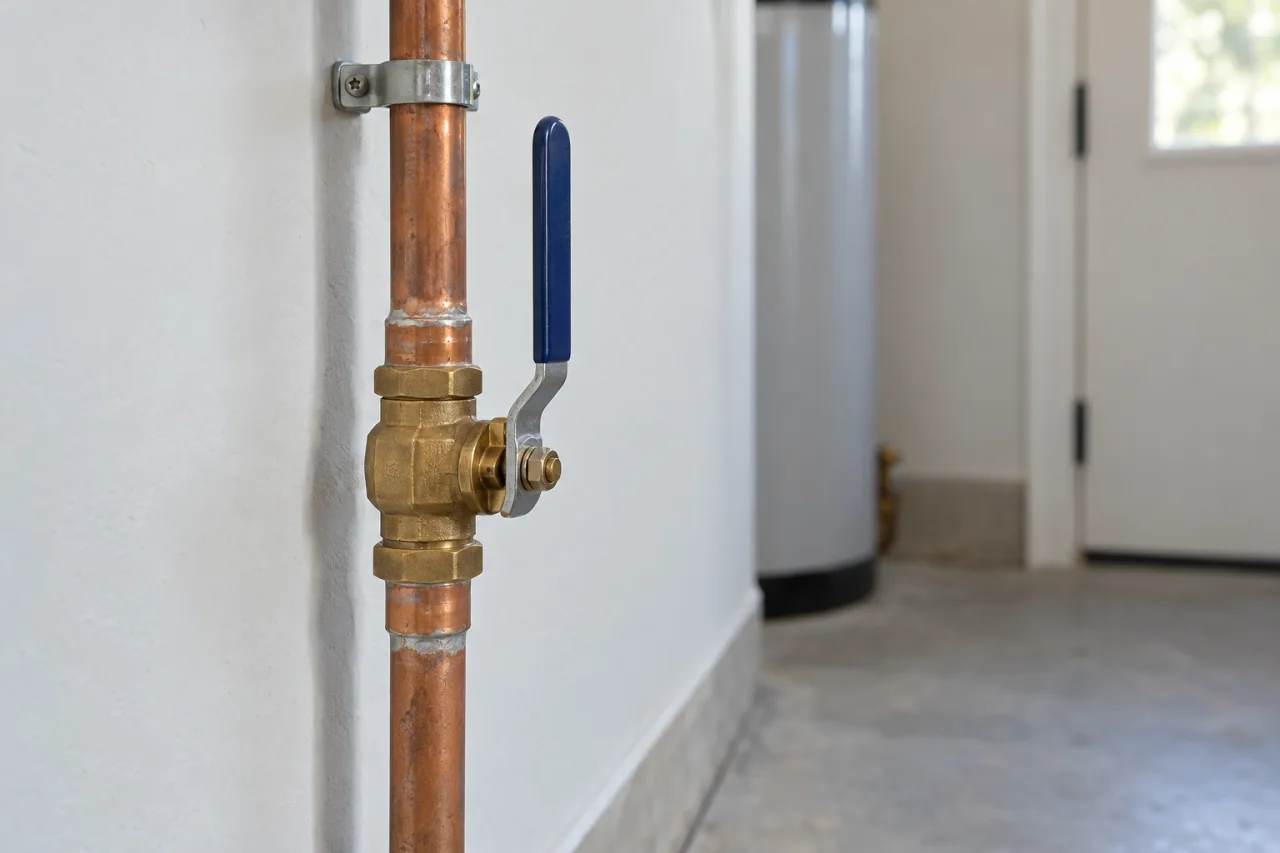
Ready NC recommends learning how to shut off water valves before a pipe bursts. Make this a daylight preparation task, not something to discover while water is spreading. Utility guidance also recommends locating the main valve ahead of freezing weather and confirming that it operates freely. If you are unsure which valve controls the house, get help identifying it. (readync.gov)
Plan for loss of heat as well. Ready NC notes that winter storms can interrupt power and heating services. An unattended property needs a deliberate cold-weather plan; for extended absences, professional guidance on shutting off and draining the system is more useful than assuming normal thermostat settings resolve every exposure. (readync.gov)
- Identify the main water shutoff and learn how your particular valve operates.
- Keep the route to the shutoff clear and make sure another responsible household member knows its location.
- Ask about a valve that is inaccessible or does not operate freely before freezing weather.
- For an extended vacancy, discuss proper system draining rather than relying on shutoff alone.
Respond cautiously to reduced flow or a suspected frozen pipe
A sudden trickle during freezing weather can indicate a frozen supply line. Check other faucets to establish whether the problem affects one area or several, but do not assume that reduced flow proves where the blockage is. If you cannot locate or safely access the frozen section, the Red Cross recommends calling a licensed plumber. (redcross.org)
For an accessible pipe without signs of rupture, National Weather Service guidance describes keeping the affected faucet open and warming the pipe gently with a heating pad, hair dryer or hot-water cloth. Never use an open flame. Do not operate electrical warming equipment around standing water. If leaking or damage is apparent, prioritize shutting off the supply safely and requesting help rather than continuing to thaw it. Review plumbing emergency warning signs when deciding what to do next. (weather.gov)
Check again after the thaw and plan the repair
After flow returns, check accessible piping and nearby surfaces for cracks or leaks. Johnston County Public Utilities specifically advises checking after thawing; restored water flow is not proof that the plumbing escaped damage. For Woodford's standard frost-proof design, a split tube may not reveal its leak until the faucet is turned on, so pay attention when returning an outdoor tap to use. (johnstonnc.gov)
When requesting help, describe which fixtures lost flow, any visible leakage and whether the water is shut off. Ask about access, repair scope and longer-term protection. The Plumbing Knight provides Emergency Plumbing Services in West End and Moore County. Emergency dispatch is available 24/7 by calling and pressing 2; after-hours calls are evaluated case by case for safety.
Questions & answers
Should I wait for a Freeze Warning before protecting pipes?
No. National Weather Service Raleigh Freeze Warnings are growing-season products, not year-round plumbing alerts. Follow the temperature forecast and prepare exposed plumbing before freezing conditions arrive. The absence of a warning does not establish that pipes are protected. (weather.gov)
Does a frost-free outdoor faucet still need attention?
Yes. Identify the model and follow its instructions. Woodford explains that its standard frost-proof design depends on correct installation and drainage; an attached hose can trap water and allow freeze damage. Other faucet designs may have different requirements. (woodfordmfg.com)
Should every faucet drip during a freeze?
The Red Cross recommends a cold-water drip from a faucet supplied by exposed piping during very cold weather. The useful choice depends on which pipe is vulnerable, rather than simply opening every faucet. Dripping supplements other protection; it is not a guarantee. (redcross.org)
Can I use a hair dryer if a pipe freezes?
A hair dryer is among the gentle warming methods listed by the National Weather Service, but do not use electrical equipment around standing water. If the pipe is hidden, damaged or unsafe to reach, stop and seek professional help. Never use a torch or open flame. (weather.gov)
What if the home will be empty during cold weather?
Ready NC recommends leaving the heat on at no lower than 55°F when away. For an extended vacancy, discuss system-specific shutoff and draining with a plumber rather than assuming that closing one valve completely winterizes the property. (readync.gov)
Sources & further reading
- American Red Cross: Preventing and Thawing Frozen Pipes
Common freeze-prone locations, outdoor hose removal and draining, cabinet opening, thermostat practices, targeted dripping and when to seek professional help.
- National Weather Service Raleigh: Weather Criteria
Seasonal limits of Raleigh-area Freeze Warnings and why a warning headline should not be the sole trigger for plumbing preparation.
- Ready NC: Winter Weather
North Carolina winter power and heat interruptions, advance shutoff planning and the minimum thermostat recommendation when away.
- U.S. Department of Energy Building America Solution Center: Insulating Plumbing Pipes
Pipe sleeve fit, continuous insulation, air sealing, exterior-wall exposure and protection options for vulnerable plumbing.
- Woodford Manufacturing: How a Standard Frost-Proof Faucet Works
Model-specific frost-proof faucet drainage, hose-related water trapping, installation pitch and delayed discovery of a split faucet tube.
- U.S. Consumer Product Safety Commission: Heat Tape Safety Guidelines
Heat cable installation precautions, GFCI protection, manufacturer-specific insulation and overlap instructions, and annual deterioration checks.
- National Weather Service: Essential Tasks After It Warms Up
Gentle warming methods for accessible frozen pipes and the prohibition on open-flame thawing.
- Johnston County Public Utilities: Protecting Water Pipes During Freezing Temperatures
Checking pipes for cracks and leaks after thawing; used as general public-utility safety guidance, not Moore County service policy.
Prepared and automatically checked on . Conditions, costs and requirements can change. Ask about the details that apply to your situation.
Continue reading
Helpful next reads
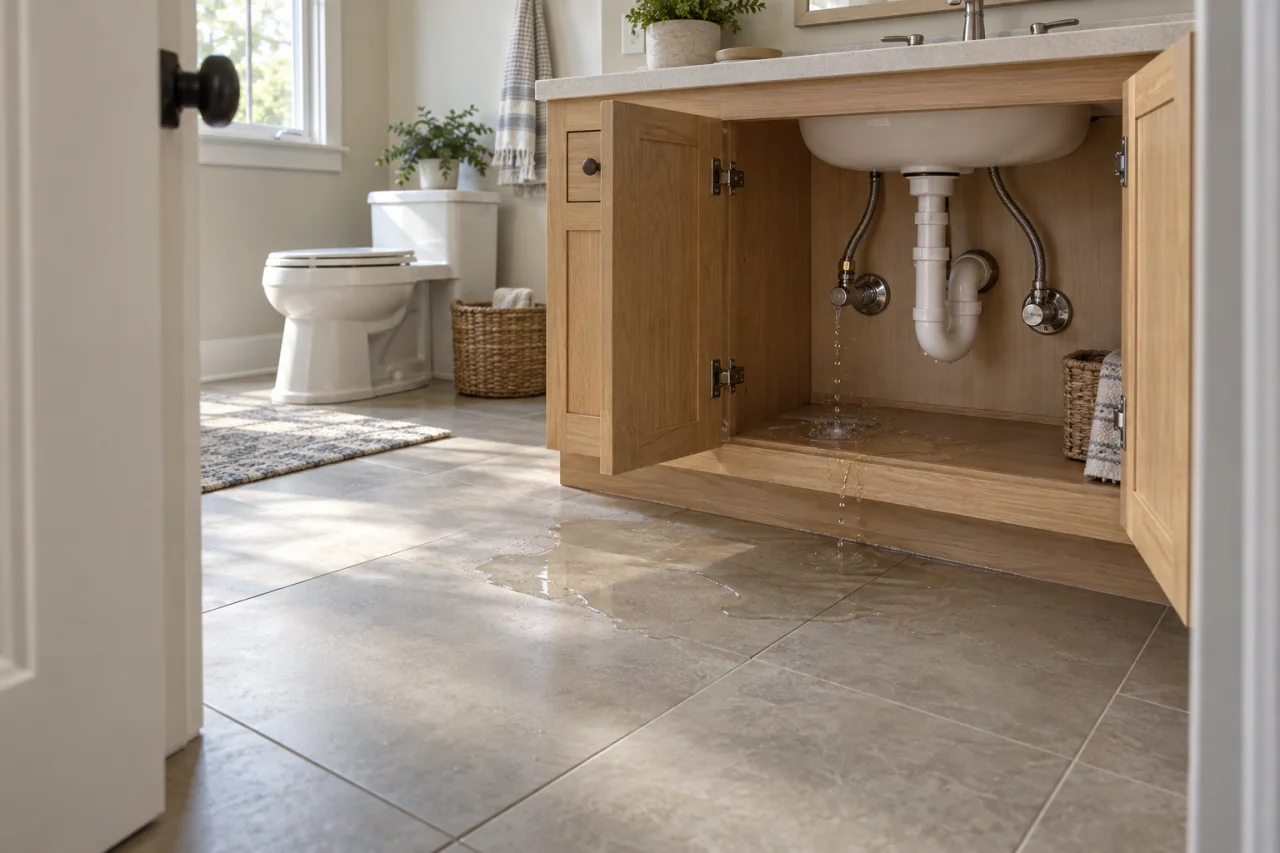
Is This a Plumbing Emergency? Warning Signs and Safe First Steps
Uncontrolled leaks, sewage backups and overflowing fixtures call for different responses. Learn when to stop water use, when to stay away and what to tell emergency dispatch.

Choosing Bathroom Fixtures: Materials, Valve Options and Repairability
A practical guide to bathroom finishes, toilet construction and valve choices—with the compatibility, cleaning and replacement-part questions worth asking before you buy.
A Running Toilet: Simple Checks and Signs of a Larger Problem
A toilet that refills on its own may be losing tank water. Learn what a dye test can reveal, why compatible parts matter and when to stop troubleshooting.