Practical guides · process
What Happens After a Backflow Assembly Fails Its Test?
A failed backflow test starts a decision—not always a replacement. Learn how to review findings, check utility requirements, compare repair scopes and finish with retesting.
What you’ll learn
- A failed test does not automatically require replacement; findings and governing requirements determine the options.
- Confirm the affected assembly, water supplier and corrective-action deadline before authorizing work.
- Repair parts must match the exact assembly, and quotes should identify retesting and reporting inclusions.
- Plan for access and possible water interruption, with separate coordination for fire-service equipment.
- Keep the passing retest and submission confirmation, not just the repair invoice.
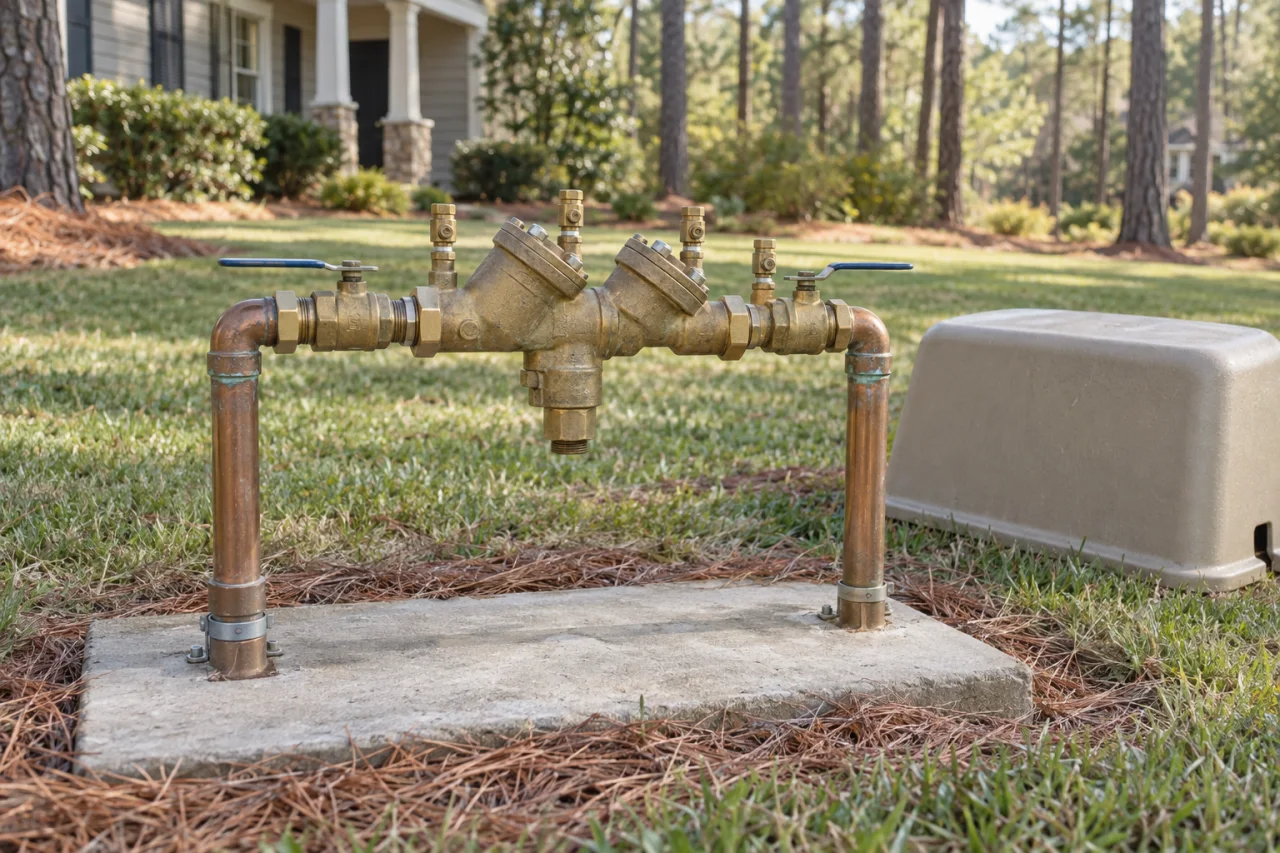
A failed backflow test does not automatically mean you need a new assembly. Cleaning or replacing internal components may be appropriate, but the assembly’s condition, suitability and water supplier’s requirements can change that answer. The practical next step is to understand what failed before approving work. For homeowners and property managers in West End and Moore County, this guide explains the typical path from the test report to repair or replacement, retesting and required records.
1. Get the findings behind the failed result
Start by asking for the complete test report, not just a pass-or-fail message. Have the tester explain which function failed and what the recorded readings indicate. A check valve that does not seal, a relief valve that does not operate correctly and a leaking shutoff valve can lead to different next steps.
Confirm that the report identifies the correct assembly and location. If your property has separate irrigation, domestic-water or fire-service assemblies, ask which connection is affected before discussing an interruption.
Describe anything you observed before testing: steady discharge, occasional spitting, freezing exposure or recent plumbing work. These observations can help the assessment, but they are not a diagnosis. The useful question is: “What does the test establish, and what still needs inspection?”
2. Check utility requirements before choosing a repair
Before authorizing parts, identify the water supplier and ask what corrective action it requires. A Moore County address does not, by itself, establish which utility’s rules govern the connection. Our guide to backflow testing requirements in Moore County provides a starting point for that distinction.
For customers of the County Water Supply Systems, the county ordinance requires notification to its Cross Connection Control Specialist within 15 days of receiving a failed test. That notification period should not be mistaken for a universal repair deadline. Confirm the deadline and any interim restrictions directly.
There is also an important local exception to “repair first.” The ordinance requires replacement with a reduced-pressure assembly when certain older double-check assemblies on lawn irrigation systems fail testing. Ask whether that provision applies before paying for a rebuild.
3. Separate a repairable fault from a replacement requirement
For an assembly that remains acceptable for its application, a typical assessment considers debris, damaged seals, worn seats and the condition of serviceable components. Manufacturer guidance includes cleaning and component replacement for several faults; a failed test alone is not a complete replacement diagnosis.
On reduced-pressure assemblies, water leaving the relief outlet does not necessarily mean the relief valve itself is the cause. Fouled checks and pressure fluctuations can also produce discharge. Simply replacing the part nearest the leak can miss the underlying problem.
Use the comparison below to organize questions, not to diagnose equipment yourself. Findings must be interpreted against the exact model’s instructions and utility requirements.
How findings can change the repair-versus-replacement discussion
| Finding or condition | Possible direction | Applicability and limitation |
|---|---|---|
| Debris on a check or sealing surface | Cleaning and inspection may be appropriate. | Cleaning does not establish a pass; retesting is still needed. |
| Worn seals or replaceable seats | A compatible component repair may be possible. | The exact model, component condition and approved parts matter. |
| Intermittent relief discharge | Evaluate pressure conditions as well as internal components. | This applies to reduced-pressure assemblies; discharge alone does not identify the fault. |
| Assembly unsuitable for required protection | Replacement or a changed installation may be necessary. | Repairing internal parts does not resolve an unacceptable assembly type. |
| Older double-check irrigation assembly covered by the county failure provision | The ordinance requires a reduced-pressure replacement. | Confirm that the county system and the specific provision apply. |
4. Confirm parts and compare complete scopes
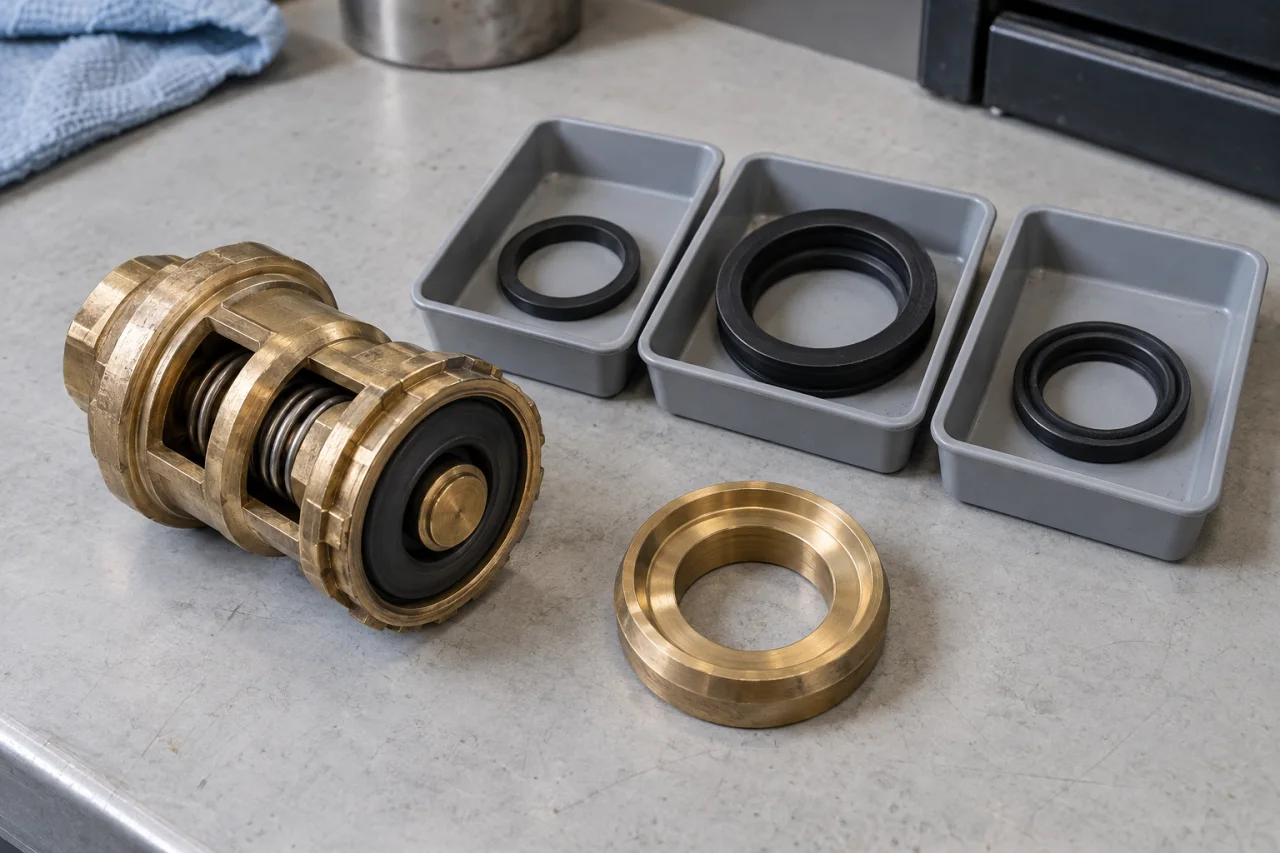
Ask the contractor to confirm the manufacturer, model, size and any relevant variant before ordering parts. Manufacturer repair guides distinguish rubber-only kits, seat kits and more complete assemblies. “A backflow repair kit” is not a sufficiently specific description.
For example, the Zurn 975XL2 maintenance instructions call for genuine manufacturer parts. Watts guidance also identifies components that are not interchangeable even within an assembly. A similar appearance is not proof of compatibility.
Request a proposal that distinguishes assessment, parts, labor, access work, retesting and reporting. Ask whether additional damaged components would require approval before the scope changes. If replacement is proposed, ask whether the quote includes necessary piping changes, drainage, enclosure adjustments and utility coordination. Compare complete scopes rather than an internal-parts quote against a fully installed replacement.
5. Prepare access and understand the interruption
Plan for a possible water interruption rather than assuming the work can happen while everything stays in use. Manufacturer maintenance procedures can require isolation and pressure release. The affected area depends on where the assembly sits in the system.
An irrigation-only interruption is different from losing water to a restaurant, office or occupied home. For business properties, planning a commercial plumbing shutdown should include the activities that depend on water and the people authorized to approve downtime.
Do not use a routine testing estimate as a promised repair duration. Access problems, ineffective shutoffs and additional findings can change the work. Fire-service assemblies need separate coordination; do not operate their valves casually.
- Which water uses will be interrupted, and who needs advance notice?
- Can the assembly be isolated with the existing shutoff valves?
- Are the enclosure, test connections and service area accessible?
- Will parts be confirmed before the planned interruption?
- If fire protection is involved, who will coordinate the required precautions?
6. Finish with retesting and submitted records
A completed repair and a passing retest are different milestones. The retest checks whether the serviced assembly meets the applicable performance requirements; the disappearance of a drip is not enough.
Moore County requires inspection and testing after installation or repair, along with reporting through its designated system. Before work begins, establish who will perform the retest, who will submit the records and how you will receive confirmation.
Keep both the original failure and the final result. If a replacement changes the model or serial number, ask that the records reflect the new assembly. Do not assume an invoice marked “repaired” also confirms utility submission. A useful closing question is: “What remains outstanding with the water supplier?”
7. Address the cause, not just the immediate failure
After a passing result, ask whether the findings suggest a separate maintenance issue. Repeated fouling may warrant attention to debris entering the assembly. Pressure-related discharge may call for a system assessment rather than repeated seal replacement.
Keep access clear and drainage unobstructed. Reduced-pressure assemblies need provisions for relief discharge; never plug an outlet to stop a leak. For exposed equipment, discuss model-appropriate freeze protection. Our guide to preparing plumbing for a freeze can help organize broader seasonal questions, but the assembly’s instructions still matter.
The Plumbing Knight offers Backflow Services for homes and businesses in West End and Moore County. When discussing a failed test, have the report, utility notice and assembly information ready. Ask to review the proposed work before proceeding, with repairability, retesting and reporting addressed together.
Questions & answers
Does a failed backflow test automatically mean replacement?
No. Some failures can be addressed by cleaning or replacing model-specific internal parts. Replacement may nevertheless be required because of the assembly’s condition, suitability or governing requirements. Certain older double-check irrigation assemblies on the Moore County water system have a specific replacement requirement when they fail.
Can I keep using water while waiting for the repair?
Ask the water supplier for instructions for the affected connection. Do not assume continued use is acceptable simply because water still flows. The utility’s direction and the hazard involved should guide interim arrangements.
Is dripping from the relief outlet proof that the entire assembly is bad?
No. On reduced-pressure assemblies, discharge can be associated with fouled checks, relief-valve components or system pressure changes. The pattern helps guide diagnosis but does not replace testing. Do not plug or restrict the outlet.
Is the Moore County 15-day notification period also my repair deadline?
Do not treat it that way. The county ordinance requires notification to its Cross Connection Control Specialist within 15 days of receiving a failed test. Confirm the corrective-action deadline separately with the utility and follow any instructions in your notice.
What records should I keep after the work?
Keep the original failed test, the repair or replacement description, the passing retest and confirmation of submission to the utility. If the assembly was replaced, retain its new identifying information so future notices and tests reference the correct equipment.
Sources & further reading
- Moore County Public Utilities & East Moore Water District Cross-Connection Control Ordinance
County-system requirements for failed-test notification, certified testing, post-repair testing, electronic reporting and replacement of specified older double-check irrigation assemblies. These provisions are not presented as rules for every utility in Moore County. ([moorecountync.gov](https://www.moorecountync.gov/DocumentCenter/View/4684/Cross-Connection-Control-Ordinance))
- Watts S-TSG: Reduced Pressure Backflow Preventers Troubleshooting Guide
Manufacturer examples of fouled checks, relief-seat faults, pressure-related discharge and corrective actions that do not necessarily require whole-assembly replacement; also supports evaluating recurring fouling. ([watts.com](https://www.watts.com/dfsmedia/0533dbba17714b1ab581ab07a4cbb521/18305-source%7D))
- Watts Series 009, LF009, LFU009, SS009 and U009 Installation, Maintenance and Repair Manual
Accessible installation, drainage and relief-discharge considerations; cleaning or replacing check components; non-interchangeable internal components; special considerations for fire-protection systems. Applies to the listed Watts series. ([watts.com](https://www.watts.com/dfsmedia/0533dbba17714b1ab581ab07a4cbb521/469892-source/638956185880000000/rp-is-009-2521.pdf))
- Zurn Wilkins Model 975XL2 Installation, Testing and Maintenance Instructions
Model-specific assessment of check seals, seats and relief components; genuine replacement parts; isolation and pressure release during servicing; testing after reassembly; access, drainage and freeze-protection considerations. ([zurn.com](https://www.zurn.com/media-library/web_documents/pdfs/installation/issm975xl2-pdf))
- Zurn Wilkins Model 975XL2 and 975XL Repair Kit Components
Distinct rubber, seat, standard and complete repair kits for specified 975XL2 and 975XL sizes, supporting the need to identify equipment and kit contents rather than assume universal compatibility. ([files.zurn.com](https://files.zurn.com/repair-parts/975xl2_and_975xl_14_to_12.pdf))
Prepared and automatically checked on . Conditions, costs and requirements can change. Ask about the details that apply to your situation.
Continue reading