
Practical guides · maintenance
Tankless Water Heater Maintenance: Why Water Quality and the Manual Matter
The right tankless maintenance plan depends on the exact heater, the water entering it and its service history. Learn what to check, what to ask and where professional work begins.
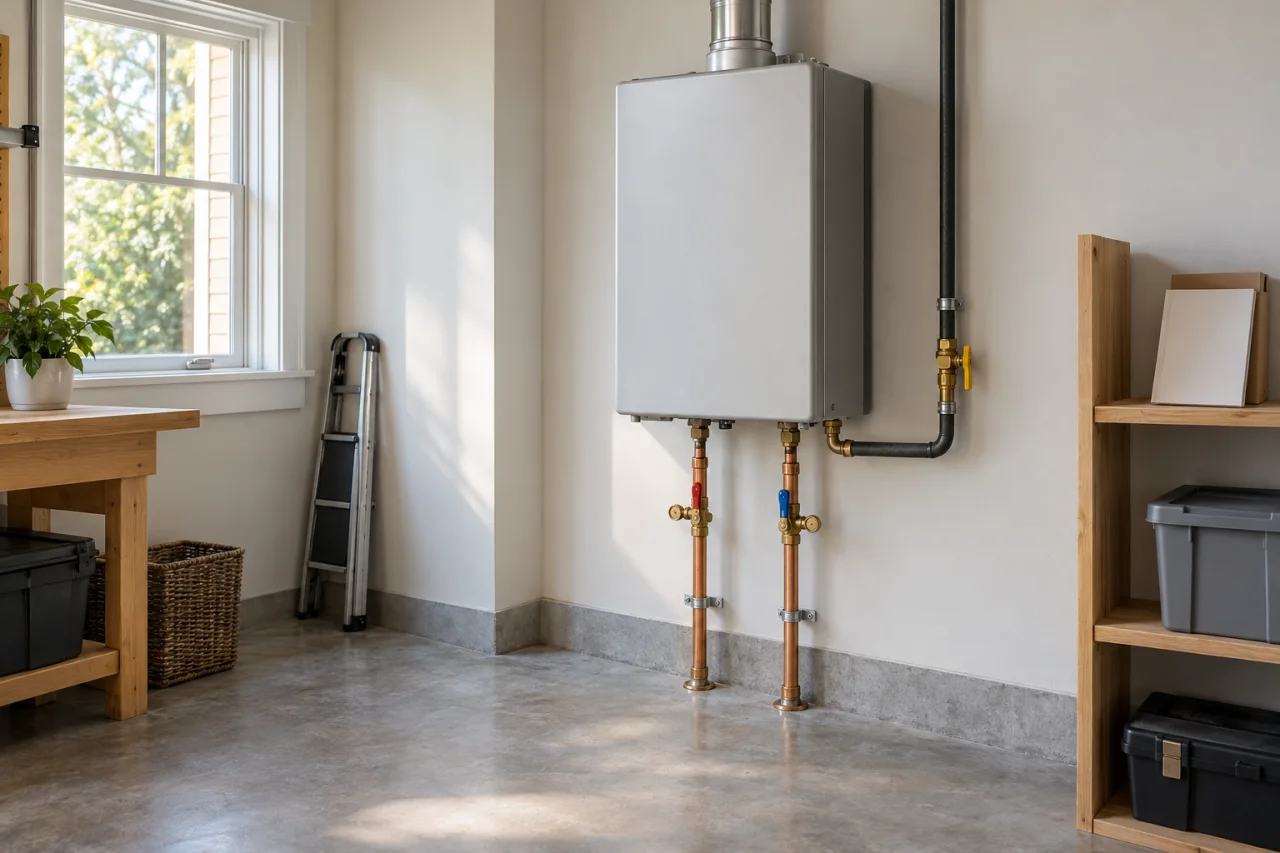
What you’ll learn
- Match maintenance instructions to the complete model number, including its suffix.
- Use water information relevant to your property; regional hardness assumptions are not enough.
- Inlet screen cleaning, descaling and professional inspection are separate maintenance items.
- Leave chemical circulation, combustion work, electrical testing and uncertain shutdown procedures to qualified professionals.
- Keep dated findings and the reason for the next recommended interval.
The right maintenance plan for a tankless water heater starts with three things: the exact model, the water entering it and its service history. A calendar reminder alone cannot tell you whether it needs screen cleaning, descaling or a broader inspection. Before buying a flushing kit or booking a visit, gather those details. This guide explains how to turn them into useful questions—and how to separate safe homeowner observations from work involving hot water, pressure, chemicals, gas or electricity.
Start with the exact model—not a generic maintenance calendar
Find the complete model number, including its letter or number suffix, and match it to the manufacturer’s documentation. A manual for a similar-looking heater may describe different filters, recirculation components or service procedures. Keep the serial number and installation paperwork with that manual.
Read the maintenance, water-quality and warranty sections together. Look for separate requirements covering inspection, inlet screens, air intake, condensate components and heat-exchanger flushing. A flush is not shorthand for every maintenance task.
For example, the Rinnai RU-series manual referenced below requires an annual professional inspection. Its water-quality guidance also explains that hard water may require more frequent flushing. Those are distinct instructions, not a universal schedule for all tankless heaters. If you cannot identify the correct manual, ask the manufacturer or a qualified service professional before choosing a procedure.
Understand the water reaching your heater
Hardness is primarily a measure of dissolved calcium and magnesium. Heating hard water can produce mineral deposits, or scale. Sediment is different: sand, dirt and other particles can collect in an inlet screen even when hardness is not the main concern.
For a home in West End, Pinehurst or elsewhere in Moore County, a regional map or a neighbor’s experience is not enough to establish the water entering your heater. Ask your utility for relevant water-quality information, or discuss appropriate testing for your supply. If treatment is installed, ask whether a sample should represent the treated water reaching the appliance.
Keep the actual result and its units, rather than only a description such as “moderately hard.” Compare it with your model’s limits. Hardness is not the only consideration: manufacturer guidance may also address pH, chlorides, iron and other substances. Visible faucet deposits are a reason to investigate, not a measurement of conditions inside the heater.
Separate filter cleaning from scale removal
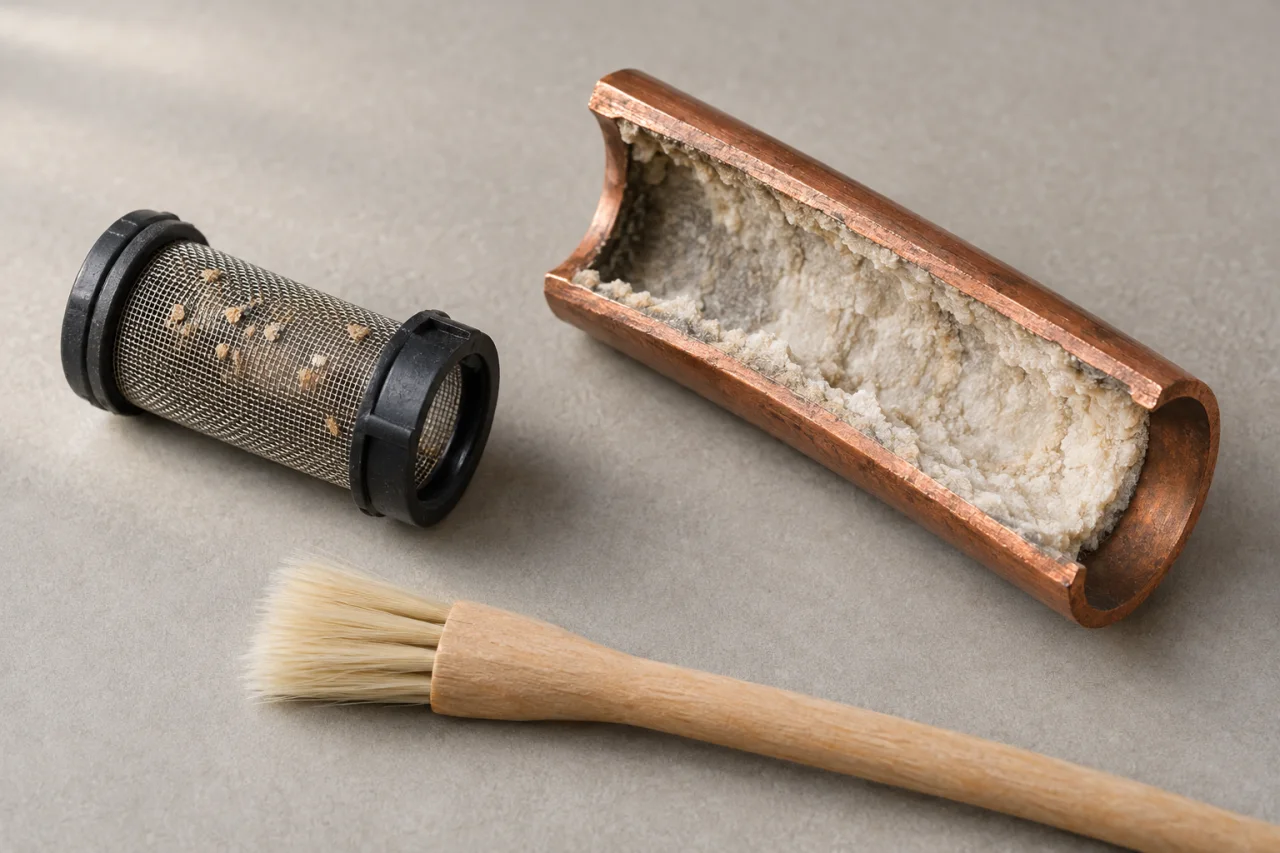
An inlet screen traps debris; descaling addresses deposits within the heat exchanger. Cleaning one does not accomplish the other. Some recirculating models also have another water screen, which is why the model suffix matters.
The distinction helps when discussing a service recommendation. Ask which maintenance item is proposed, what condition it addresses and whether additional manual-required work is included. Avoid treating every flow problem as proof that the heat exchanger needs descaling.
Different maintenance tasks address different conditions; this is a planning comparison, not a troubleshooting diagnosis.
| Maintenance item | What it addresses | Applicability and limitation |
|---|---|---|
| Inlet screen cleaning | Debris trapped at the water inlet | Does not descale the heat exchanger; safe isolation and draining depend on the model. |
| Heat-exchanger flushing or descaling | Mineral buildup within the heater’s waterways | Does not replace screen cleaning or other inspection requirements. |
| Recirculation screen cleaning | Debris in an additional screen on equipped models | Not every heater has this component; confirm the model and configuration. |
| Air-filter maintenance | Dust or lint affecting the air intake | Separate from water-side maintenance; cabinet access calls for appropriate safety precautions. |
Choose the flushing interval and solution from applicable guidance
An annual reminder can be useful, but it should not replace model-specific guidance. Rinnai’s general flushing page recommends at least annual flushing; its maintenance FAQ says intervals depend on household water quality. Navien’s maintenance guidance likewise says frequency varies with installation, location, application and operation.
Use those statements as reasons to clarify the recommendation for your heater—not to select whichever interval sounds easiest. Ask which manual instruction applies and whether the water results or observed deposits justify a different interval. If guidance appears inconsistent, have the manufacturer or service professional resolve it.
Cleaning instructions also differ. The referenced Navien NPE-A2/S2 manual describes a diluted cleaning solution, while Rinnai’s general flushing guide specifies white vinegar. Do not transfer a solution, concentration or circulation time from another brand’s instructions. This article deliberately does not provide a universal flushing recipe.
Check service access without operating unfamiliar valves
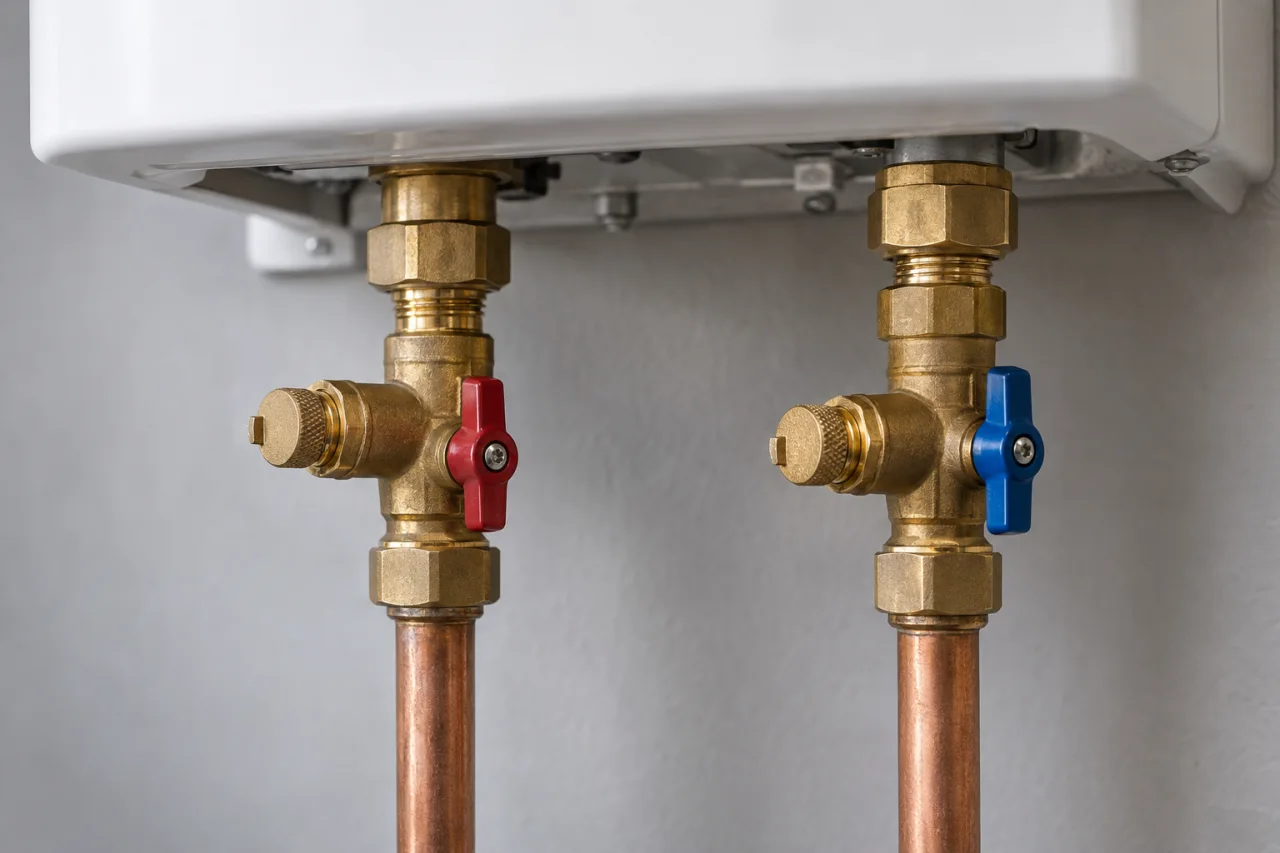
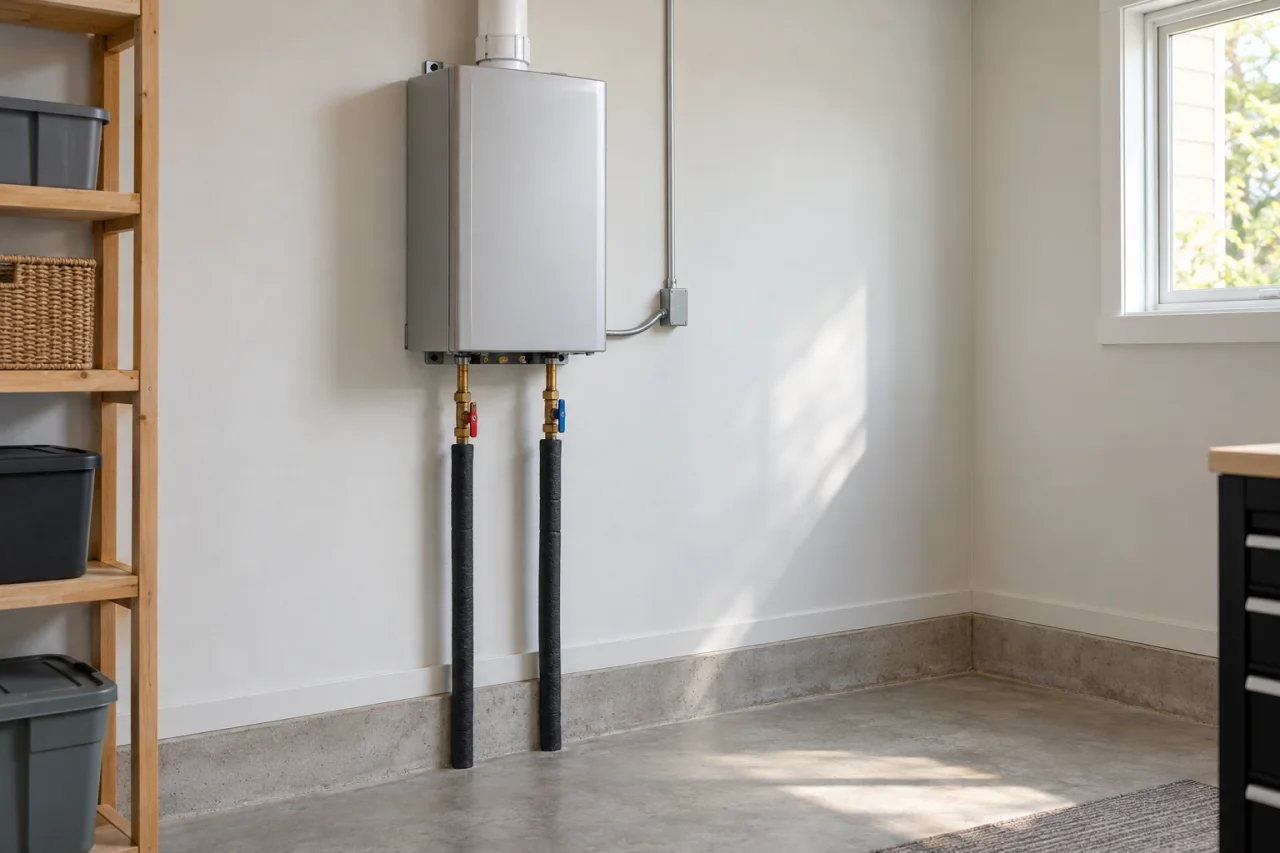
Service or isolation valve assemblies allow a professional to separate the heater from the building’s water piping and connect flushing equipment through service ports. They are not the same as the pressure-relief valve, and the presence of ordinary shutoffs does not necessarily mean the installation has suitable flushing access.
From a safe position, you can photograph the piping beneath the closed cabinet before requesting service. Leave caps and handles alone. Hot water, trapped pressure and unfamiliar valve arrangements make trial-and-error operation a poor approach.
Ask whether suitable service connections are present and accessible. If valves are missing, leaking or difficult to operate, discuss that work separately from descaling. Access, required parts and equipment can change the proposed scope; a quote labeled simply “maintenance” may not explain these differences.
Know what to observe—and what not to attempt
Useful homeowner observations include when a symptom began, whether it affects one fixture or several, visible drips and the exact message shown on the controller. Record the message before following any reset instructions. Repeatedly clearing a warning is not a maintenance plan.
For an observation-focused starting point, read Checking Your Water Heater For Damage. Keep the heater’s cabinet closed and leave combustion checks, gas-pressure adjustments, electrical testing, chemical circulation and uncertain draining procedures to qualified professionals. Even filter removal can release water and requires the shutdown sequence in the correct manual.
A gas odor is not a routine maintenance issue. Leave the building without operating switches or using a phone inside, then contact the gas supplier from a safe location. If the supplier cannot be reached, call the fire department. Do not attempt a flush or restart.
Consider treatment without treating it as a cure-all
Treatment should answer a measured problem. A water softener reduces hardness minerals, but a screen that catches particles does not perform that same function. Ask what any proposed treatment changes, whether it is compatible with the heater and what ongoing maintenance it requires.
Do not assume treatment eliminates appliance maintenance. Screens, air pathways and other model-specific components still need attention. If the recommendation includes a longer interval between descaling visits, ask for the basis and keep it with the water results.
Likewise, flushing is not a promised cure for every hot-water complaint or damaged component. Where assessment identifies a broader problem, the decision may be whether to repair or replace a water heater rather than repeat maintenance without a diagnosis.
Keep records that make the next decision easier
A useful maintenance record explains more than “water heater serviced.” It helps the next professional understand what was done and why the schedule was chosen. Keep invoices, findings and recommendations together. Records do not guarantee warranty coverage; the applicable manufacturer’s terms control.
When comparing proposals, ask what is included and what would require separate approval. Filter cleaning, a heat-exchanger flush, valve replacement and diagnosis are different scopes of work.
For Tankless Water Heaters in West End and Moore County, The Plumbing Knight can discuss what you have observed, arrange an appropriate assessment and review proposed work before proceeding. Explore Water Heater Services if you are unsure which type of help fits. Bring your model information and records so the conversation begins with your equipment—not a blanket annual-flushing rule.
- Save the complete model and serial number, matching manual and available installation records.
- Keep dated water results with their units and note any treatment equipment serving the heater.
- Request an itemized scope distinguishing inspection, screen care, descaling and any valve repairs.
- Record the work completed, findings, parts or cleaning product used, and any unresolved concerns.
- Keep the next recommended maintenance date and the reason for that interval.
Questions & answers
Does every tankless water heater need annual flushing?
Do not apply one interval to every heater. Some manufacturer guidance calls for annual flushing, while other guidance ties frequency to water quality and operating conditions. Follow the instructions for your exact model and ask how water test results affect its schedule. An annual inspection and a descaling interval are separate requirements.
Does cleaning the inlet filter remove scale?
No. Cleaning the inlet screen removes trapped debris. Descaling addresses mineral deposits inside the heater’s waterways. One task does not replace the other, and neither replaces other maintenance specified in the manual.
Can I use vinegar or a store-bought descaler?
Only use the solution and procedure permitted for your model. Manufacturer instructions differ, so a product marketed for tankless heaters is not automatically suitable. Have a qualified professional resolve questions about compatibility, concentration, rinsing and disposal rather than experimenting.
Does a water softener eliminate maintenance?
No. A softener can reduce hardness minerals, but it does not replace filter care, appliance inspections or other manual requirements. Ask whether treatment changes the recommended flushing interval and how the treatment equipment itself should be maintained.
What if I cannot find any maintenance records?
Gather the model and serial number, installation information, current symptoms and available water test results. Request an assessment rather than assuming the heater needs only flushing. Start a dated record with the findings and keep the next maintenance recommendation with it.
Sources & further reading
- U.S. Geological Survey: Hardness of Water
Explains dissolved calcium and magnesium, scale formation when hard water is heated, and why national hardness maps should not determine individual-property decisions. ([usgs.gov](https://www.usgs.gov/water-science-school/science/hardness-water?qt-science_center_objects=0))
- Rinnai: Residential Frequently Asked Questions
Supports the distinction between periodic inlet-screen cleaning and scale-removal flushing, dependence of intervals on household water quality, and professional flushing guidance. ([rinnai.us](https://www.rinnai.us/residential/faq))
- Rinnai: 13-Step Tankless Water Heater Flushing Procedure
Provides Rinnai’s general at-least-annual flushing recommendation, vinegar guidance, pressure precautions and direction to consult the manufacturer’s manual. It is not presented as a procedure for every model. ([rinnai.us](https://www.rinnai.us/residential/flushing-my-rinnai-tankless-water-heater))
- Rinnai RU-Series Tankless Water Heater Installation and Operation Manual
Supports annual professional inspection for the listed RU models, water-quality limits beyond hardness, potentially more frequent flushing with hard water, isolation valves, and gas-odor safety instructions. ([media.rinnai.us](https://media.rinnai.us/salsify_asset/s-378ffc11-7201-4965-a2f1-22e2286e360c/100000467-N%20Series%20Residential%20Condensing%20Installation%20and%20Operation%20Manual.pdf))
- Navien NPE-A2/S2 User’s Information Manual
Documents NPE-A2/S2 model identification, separate inlet and recirculation filters, draining precautions, service-valve flushing arrangements, diluted cleaning solution and warnings about improper maintenance. ([navieninc.com](https://www.navieninc.com/downloads/npe-2-user-s-information-manual-en/download))
- Navien: Simple Tips for Maintaining Your Navien Unit
States that maintenance frequency varies with installation, location, application and operation; distinguishes inlet screens, air filters, condensate care and waterway flushing. ([navieninc.ca](https://www.navieninc.ca/blog/notice/simple-tips-for-maintaining-your-navien-unit))
- Navien NPE Downloads and Service Safety Guidance
Supports referring hazardous gas, combustion, venting, electrical and maintenance work to qualified professionals and following applicable product documentation. ([navieninc.com](https://www.navieninc.com/series/npe-s/downloads))
Prepared and automatically checked on . Conditions, costs and requirements can change. Ask about the details that apply to your situation.
Continue reading
Helpful next reads
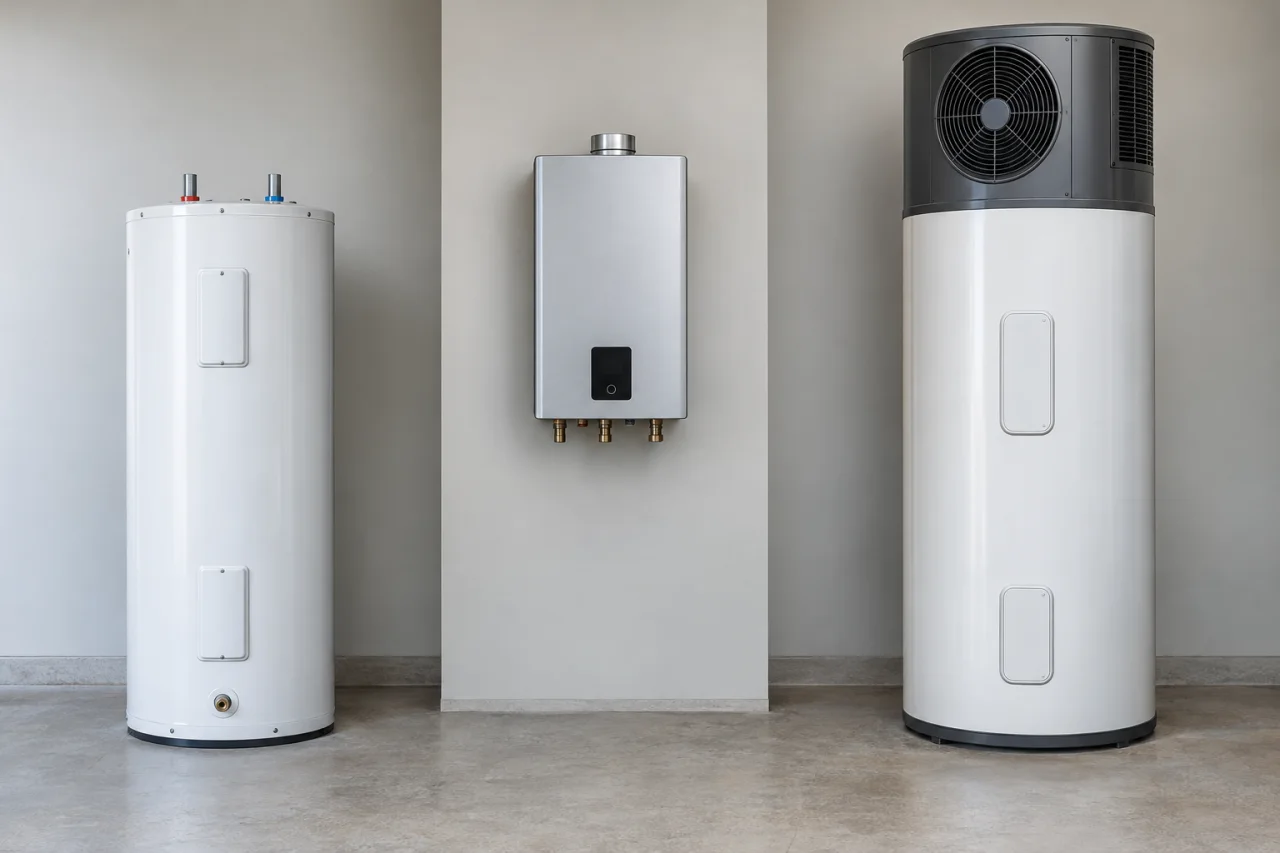
Tank, Tankless or Heat Pump: Comparing Water Heater Options
Choose a water heater around your busiest hot-water period, installation space and existing utilities—not a headline efficiency claim.
What Adds to the Cost of Converting to a Tankless Water Heater?
The tankless unit is only part of a conversion budget. Understand the supply, venting, drainage, location and comfort decisions that shape the complete installation.