
Practical guides · maintenance
Grease Trap and Interceptor Maintenance for Food-Service Properties
A practical grease-control plan connects kitchen habits, equipment instructions, utility requirements and useful records—before slow drainage becomes a backup.
What you’ll learn
- Identify the serving utility and actual equipment before selecting a maintenance interval.
- Use applicable requirements, manufacturer instructions and observed loading together—not a universal schedule.
- Dry cleanup and separate cooking-oil collection reduce what reaches the interceptor but do not replace maintenance.
- Confirm cleaning scope, lawful disposal and recordkeeping responsibilities before service.
- Recurring slow flow after cleaning calls for assessment of the connected plumbing, not assumptions.
A restaurant’s grease-control plan should do more than put a pump-out date on the calendar. It should identify the equipment, reduce what enters it, document service and give managers a clear response when drainage changes. Fats, oils and grease can accumulate in piping and restrict flow even when the kitchen appears to be operating normally. For food-service properties in West End and across Moore County, start with the serving wastewater utility’s requirements and the installed equipment’s instructions, then use service findings to keep the plan appropriate for the kitchen.
Start with the property, utility and equipment
Before choosing a service interval, establish who receives the restaurant’s wastewater. A Moore County address alone does not establish which utility’s requirements apply. Ask the serving utility to confirm the rules for the specific property and equipment.
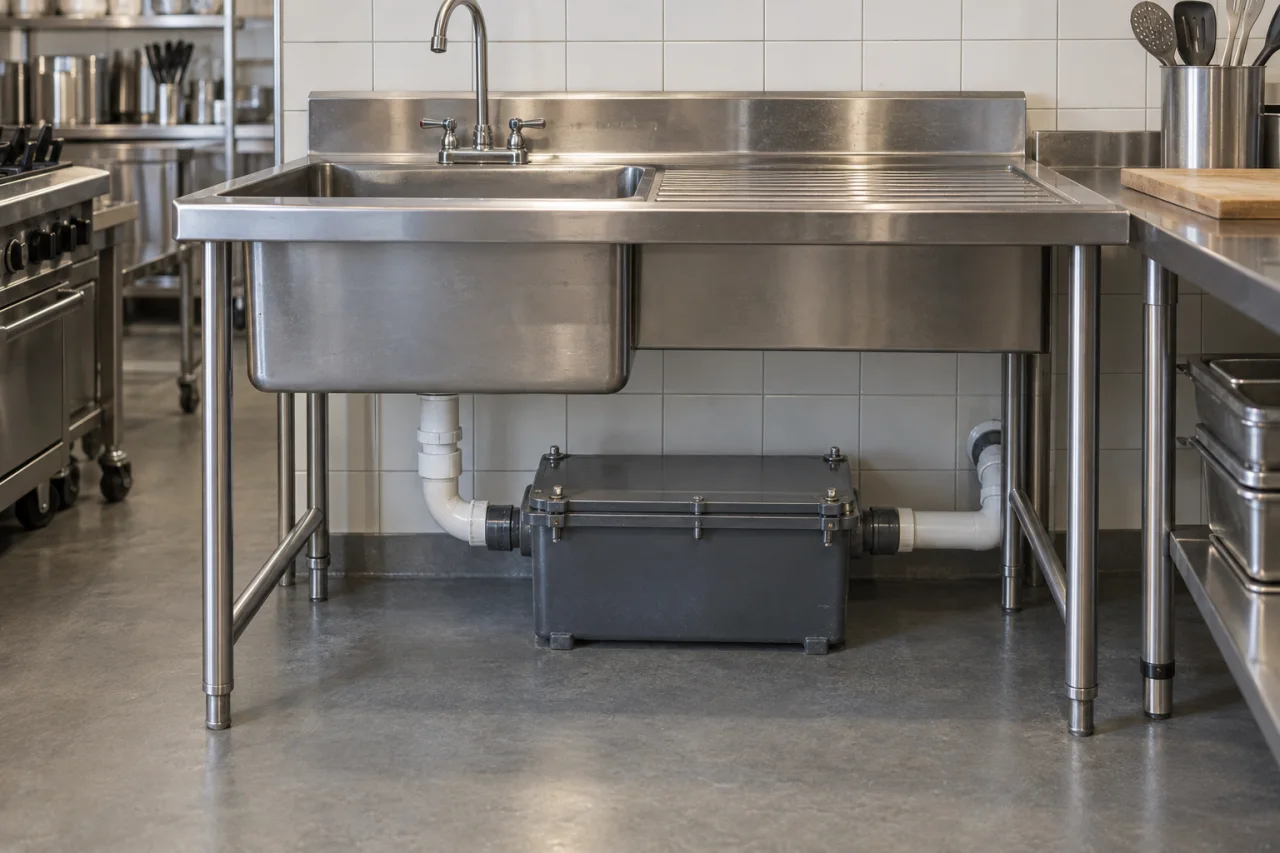
Build a simple equipment inventory rather than relying on the phrase “the grease trap.” Include every unit, its location and the fixtures connected to it. The state food-service assessment checklist uses these details to evaluate grease management. For leased premises, also clarify who arranges service and who keeps the documentation. Treat that responsibility discussion as part of planning a commercial plumbing repair, not something to resolve during an overflow.
- Identify the wastewater utility serving the property and its grease-control contact.
- Record each unit’s manufacturer, model, location and connected fixtures.
- Locate the equipment instructions and existing service records.
- Assign responsibility for scheduling, record retention and required reporting.
Understand which grease-control device you have
“Grease trap” and “grease interceptor” are often used loosely. A compact unit beneath a sink and a larger tank serving multiple fixtures both capture grease, but their access, storage capacity and maintenance instructions are not interchangeable.
Gravity-type interceptors use retention time and separation: grease rises while heavier solids settle. Compact equipment has its own rated flow and storage limits. Identify the actual model before borrowing another restaurant’s cleaning routine. A larger enclosure or an outdoor location does not, by itself, establish an appropriate interval.
Equipment differences to confirm before setting a maintenance plan
| Equipment arrangement | Planning priority | Important limitation |
|---|---|---|
| Compact under-sink unit | Confirm model, connected fixtures and usable service access. | Do not apply a larger tank’s pumping schedule. |
| Larger gravity-type interceptor | Account for compartments, settled solids and pumping access. | Tank size alone does not establish maintenance frequency. |
| Multiple connected units | Identify every unit and obtain system-specific instructions. | Do not assume one inspection point represents the entire system. |
Set the interval from rules and actual loading
For properties subject to Moore County’s published FOG Program, grease-trap service must be completed and documented at intervals not exceeding 90 days. The utility director can require more frequent cleaning; an extension requires investigation rather than an owner’s assumption. Under-sink interceptors have a separate provision: documented daily service or a manufacturer-recommended frequency, with the user responsible for demonstrating compliance when service is not daily.
Confirm how those provisions apply to your installation. A permitted maximum interval is not a reason to wait when the equipment needs earlier attention.
Ask the service provider to compare observed accumulation with the model’s maintenance limits. Revisit the plan when meal counts, operating days or menu preparation change. Do not import a universal percentage-full rule from another device or jurisdiction.
Reduce grease loading before the first rinse
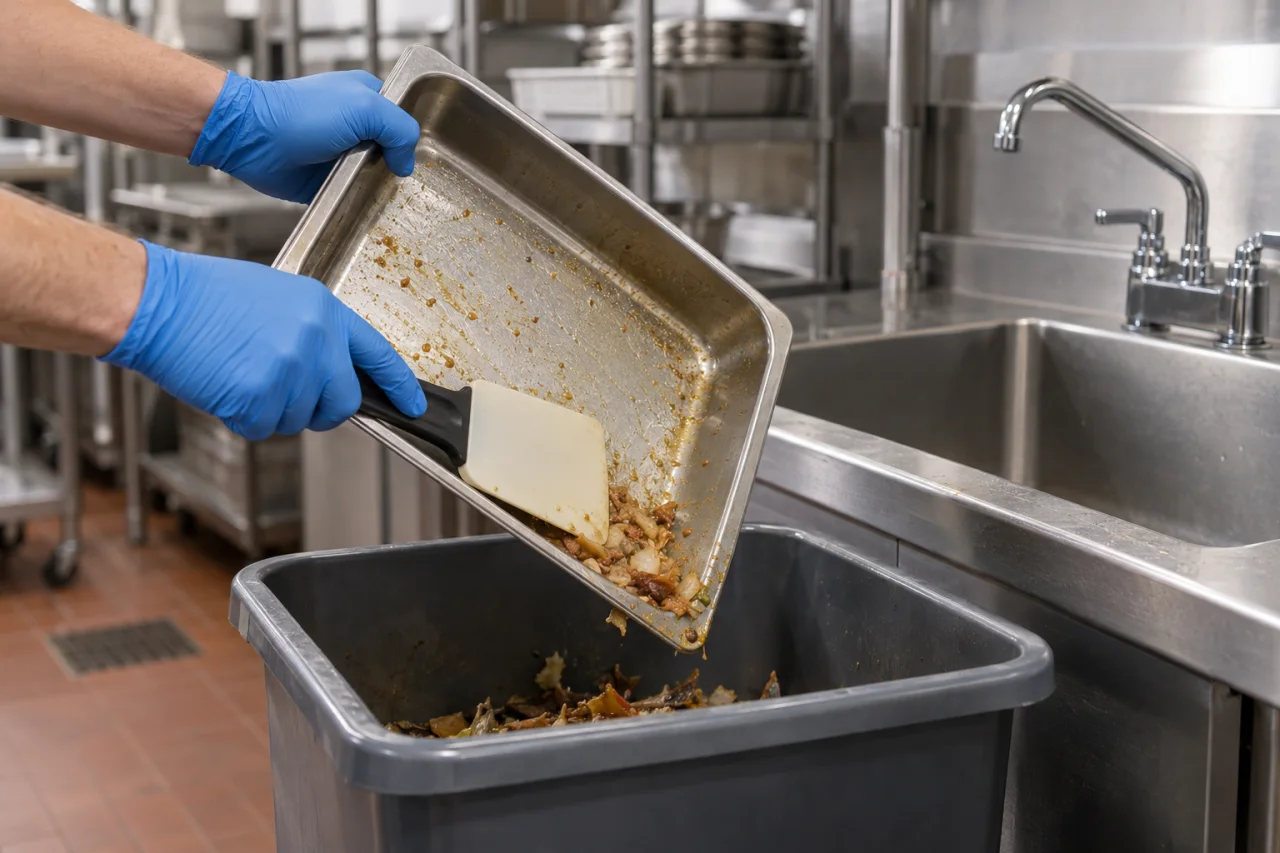
The most useful grease-control work happens before wastewater reaches the interceptor. Dry cleanup removes residues instead of washing them into the plumbing. It complements required washing and sanitation; it does not replace either.
Make the preferred method convenient. A scraper beside the wash station and an accessible waste container are more useful than a rule employees cannot easily follow. Include floor and equipment cleanup in training, because grease does not enter drains only through dishwashing.
Keep outdoor oil containers covered and watch for leaks or spills near storm drains. Separate used cooking oil collection from interceptor-waste handling: they are different waste streams, and the receiving contractor should confirm what belongs in each container.
- Scrape pans, plates and utensils before washing.
- Collect used cooking oil separately rather than pouring it into sinks.
- Keep suitable drain screens in place and empty captured debris into waste containers.
- Provide scrapers, absorbent materials and covered transfer containers where employees need them.
- Train new employees and reinforce the same practices across shifts.
Agree on cleaning scope and waste handling
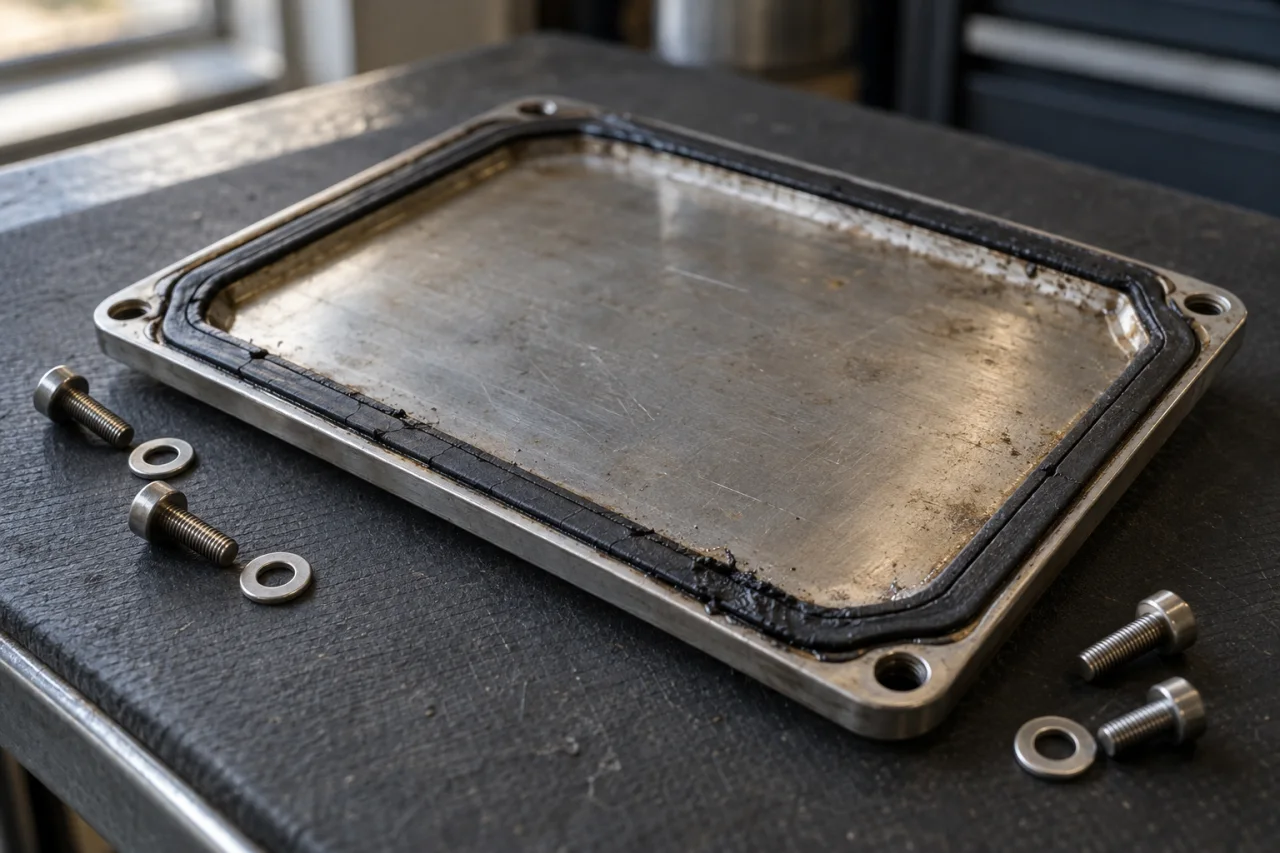
Ask what “cleaning” includes before approving the visit. The state assessment checklist specifically distinguishes complete pumping and cleaning from removing only the grease layer. Equipment instructions may also address sediment removal, refill procedures and cover-gasket inspection.
For properties governed by Moore County’s program, removed water cannot be returned to the trap or sanitary sewer without prior written approval. Captured material must be disposed of appropriately under local regulations. Ask the hauler to explain the disposal destination and applicable authorization.
Plan access and timing around kitchen operations. Keep service covers reachable, and discuss any interruption to connected fixtures beforehand. Interceptor cleaning and drain-line clearing are separate scopes; confirm whether both are needed rather than assuming one includes the other.
- Does the proposed service include complete cleaning rather than surface grease removal alone?
- Which compartments and accessible components are included?
- How will worn seals, damaged covers or other defects be reported?
- What waste-hauling documentation will be supplied?
- Is connected drain-line work included or quoted separately?
Keep records that show more than a scheduled date
Keep a maintenance log that makes the next decision easier: service date, unit serviced, inspection or pump-out performed, observed grease and solids levels when measured, defects, repairs and the next planned visit. Retain invoices and hauling documentation alongside it. A calendar reminder shows intent; a completed service record shows what happened.
Moore County’s published program requires covered users to retain written maintenance records on site for three years. It also requires a copy of each service record to reach the Grease Trap Coordinator no later than 15 days after the end of the month in which maintenance occurred.
Assign one person to check submissions and preserve a copy. Ask the utility to confirm its current submission method and any required form.
Respond to restricted flow without guessing at the cause
Record slow drainage, recurring odors, gurgling and wastewater appearing at another fixture when a sink empties. These observations help describe the problem, but none alone proves that the interceptor is full.
During professional inspection, an abnormally high liquid level can point to a restricted fitting, line or filter. Persistent odors also warrant attention to covers, seals and the plumbing’s venting arrangement. If cleaning does not restore normal drainage, request assessment of the connected piping; Drain Cleaning may be a separate part of the solution.
If wastewater is backing up or overflowing, stop using affected fixtures and keep people away from the contaminated area while seeking help. Review plumbing emergency warning signs before an incident. Do not open a large interceptor to investigate, leave an access opening unattended or allow employees to enter the tank.
Turn the findings into a workable next step
Before the next visit, gather the equipment details, utility requirements, last service record and a brief description of any symptoms. Ask whether the immediate need is cleaning, a component repair, connected-pipe assessment or a combination. Request a clear distinction between the proposed work and anything that may require a separate specialist or waste hauler.
The Plumbing Knight provides Commercial Plumbing, including grease trap repair and maintenance, for businesses in Moore County. Discuss what you have observed, arrange an appropriate assessment and review the proposed work before proceeding. For recurring trouble, the goal should be a documented maintenance decision—not simply repeating the last service without understanding why the problem returned.
Questions & answers
Can a restaurant use one maintenance schedule for every grease-control device?
Not without checking each unit. Equipment type, manufacturer instructions, connected fixtures and the applicable utility requirements can differ. Identify every device and have the responsible provider confirm the schedule for each.
Does collecting fryer oil eliminate the need for interceptor maintenance?
No. Separately collecting used cooking oil reduces what enters the drains, but cookware washing and kitchen cleanup still produce grease-bearing wastewater. Oil collection and interceptor maintenance serve different purposes.
Can grease-dissolving chemicals replace pumping?
Do not treat them as a substitute. The Schier guidance warns that chemicals can temporarily dissolve grease, allowing it to pass through the interceptor and harden downstream. Check equipment instructions and utility restrictions before introducing any treatment product.
What if the drains remain slow after the interceptor is cleaned?
Request an assessment of the connected piping rather than assuming another pump-out will solve it. A restricted fitting, filter or drain line may need separate attention. Explain which fixtures are affected and whether the problem changed after cleaning.
Should restaurant employees enter a large interceptor to clean it?
No. Keep employees out of the tank. Grease interceptors can contain hazardous atmospheres and present engulfment and fall hazards. Arrange appropriate professional service and keep access covers secured.
Sources & further reading
- Moore County FOG Program — Sewer Use Ordinance Section 2.7(b)(3)
Moore County-specific maintenance provisions, conditional interval changes, under-sink requirements, restrictions on returning removed water, disposal responsibility, three-year on-site record retention and service-record submission deadline. These provisions are presented conditionally for properties subject to the program. ([moorecountync.gov](https://www.moorecountync.gov/DocumentCenter/View/255/FOG-PDF))
- Schier Great Basin Grease Interceptors Owner’s Manual, June 2024
Model-specific capacity and scheduling considerations; reassessment after menu or meal-volume changes; complete contents removal, refill and gasket guidance; screen use; warnings against grease-reducing chemicals; maintenance logs and interceptor safety precautions. Manufacturer guidance is not treated as universal instructions for other equipment. ([product-assets.schierproducts.com](https://product-assets.schierproducts.com/asset/OhBhLkLYlD8KmuSDvACZx5c1suyiygSLjdEQ7Cph.pdf))
- EPA — Controlling Fats, Oils, and Grease Discharges from Food Service Establishments
Grease accumulation can restrict sewer flow and cause blockages; food-service operations can reduce discharges through management practices, separate used-oil collection and grease-capture devices. Also supports distinguishing collected cooking oil from grease-trap waste. ([epa.gov](https://www.epa.gov/system/files/documents/2021-07/pretreatment_foodservice_fs.pdf))
- North Carolina — Best Management Practices for Fats, Oils, and Grease
Dry cleanup before washing, scraper use, staff education, spill-prevention tools, separate fryer-oil collection and secure outdoor waste-oil storage. ([deq.nc.gov](https://www.deq.nc.gov/environmental-assistance-and-customer-service/fog/bmps-fog2/download))
- North Carolina — Fats, Oil and Grease Management Food Service Assessment Checklist
Equipment inventory, responsible-person identification, on-site maintenance logs, complete cleaning versus grease-layer removal, clean-water refill, connected-fixture review, employee training, covered storage, hauler authorization and final disposal questions. ([deq.nc.gov](https://www.deq.nc.gov/environmental-assistance-and-customer-service/fog/food-service-assessment-checklist/download))
- E.C. Babbert — Grease Interceptor Operation & Maintenance
Gravity-type interceptor separation, retention and storage considerations; compartment maintenance; cover and gasket inspection; high liquid levels as a possible indication of restricted fittings, lines or filters; venting-related odor considerations; prohibition on entering an interceptor for maintenance. ([ecbabbert.com](https://www.ecbabbert.com/interceptors/grease/operation-maintenance/))
Prepared and automatically checked on . Conditions, costs and requirements can change. Ask about the details that apply to your situation.
Continue reading
Helpful next reads
Planning a Commercial Plumbing Repair Without Overlooking Business Operations
A plumbing repair plan should account for people, sanitation and business continuity—not just the damaged pipe. Use this framework to prepare for service interruptions and reopening.
Should You Use Chemical Drain Cleaner on a Slow Drain?
Chemical cleaner is not a diagnosis for a slow drain. Learn the label limits, safer initial checks and essential information to share if you have already used a product.
What Determines the Cost of Drain Cleaning?
Two clogged drains can require very different work. Learn how location, access, equipment and recurring symptoms shape the scope—and which questions make estimates easier to compare.